
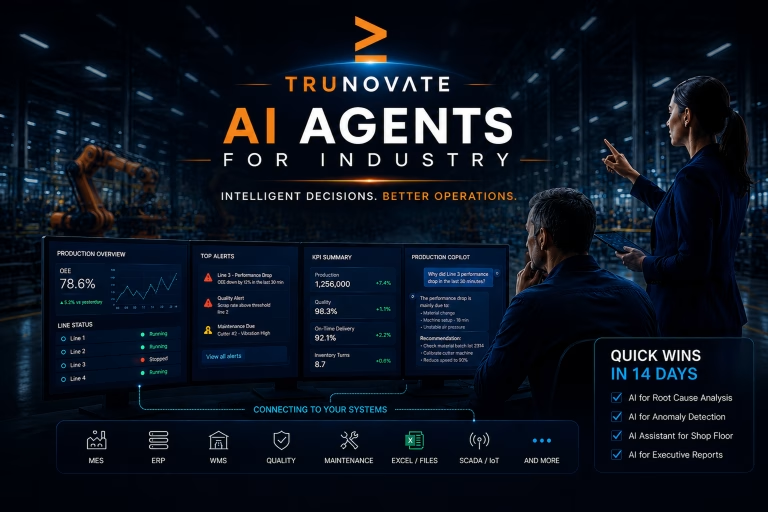
Manufacturing Agents: Turning Factory Data into Real-Time Operational Decisions
Lea Tarshish, CEO at Trunovate | PlantSharp MES
For many years, manufacturing organizations have invested in data collection, dashboards, reports, and business intelligence tools. These systems have helped plant managers, production leaders, quality teams, maintenance teams, and executives gain better visibility into what happens on the production floor.
But in today’s manufacturing environment, visibility alone is no longer enough.
Factories are operating under growing pressure: shorter delivery times, stricter quality expectations, labor shortages, rising energy costs, regulatory requirements, supply chain volatility, and constant demand for higher productivity. At the same time, the amount of operational data generated by machines, production lines, ERP systems, quality systems, MES platforms, sensors, and shop-floor applications continues to grow.
The challenge is no longer only to collect data.
The challenge is to understand what matters, why it matters, and what action should be taken now.
This is where Manufacturing Agents are becoming a meaningful next step in industrial digital transformation.
From Dashboards to Operational Intelligence
Dashboards are important. They organize data, visualize KPIs, and help managers monitor production performance, quality, downtime, inventory, energy consumption, and delivery status.
However, dashboards still depend on the user to know what to look for, where to look, and how to interpret what they see.
A production manager may see that output is lower than planned.
A quality manager may see an increase in rejects.
A maintenance manager may see repeated machine stoppages.
An operations manager may see WIP accumulating between stages.
Each signal may appear in a different report, system, or dashboard. The real operational value begins when the system can connect these signals, identify the pattern, explain the impact, and recommend where to focus.
Manufacturing Agents are designed to support exactly this type of decision-making.
What Are Manufacturing Agents?
Manufacturing Agents are AI-powered operational assistants that focus on specific areas of factory management. Instead of asking users to manually search through multiple dashboards, each agent analyzes data within its domain, detects exceptions, identifies trends, and helps managers understand which action may be required.
The concept is simple:
each operational area needs its own intelligent assistant.
A Production Agent can follow work orders, cycle counts, downtime, output, losses, and shift performance.
A Quality Agent can analyze rejects, deviations, inspections, SPC trends, non-conformities, and recurring quality issues.
A Digital Forms Agent can monitor electronic records, checklists, approvals, deviations, and process documentation.
A Maintenance Agent can connect equipment history, stoppages, failures, preventive maintenance, and abnormal machine behavior.
A WIP Agent can track in-process inventory, bottlenecks, waiting time, and movement between production stages.
A Weighing Agent can support material accuracy, recipe execution, batch traceability, and production compliance.
An Energy Agent can identify abnormal consumption patterns, energy intensity by line or product, and operational waste connected to utilities.
Together, these agents create a broader operational intelligence layer across the factory.
Why MES Is the Natural Foundation
For Manufacturing Agents to provide real value, they must be connected to reliable operational data. This is why the MES layer is so important.
The Manufacturing Execution System reflects the real-time operational reality of the factory: work orders, machines, operators, materials, batches, quality results, downtime, WIP, maintenance events, weighing activities, energy consumption, and digital production records.
ERP systems provide the business context: items, orders, customers, inventory, planning, costing, and supply chain information.
When Manufacturing Agents can connect MES data with ERP data and other industrial sources, they can create a much more complete picture of what is happening in the factory.
For example, if a production order is delayed, the ERP may show the delay, but not necessarily explain it. The reason may be machine downtime, material shortage, quality hold, incorrect weighing, missing approval, abnormal cycle time, WIP congestion, or a planning gap.
A Manufacturing Agent can help connect these points and guide the manager toward the real operational cause.
Example 1: Food Manufacturing
In food manufacturing, production environments are highly dynamic. Lines may run different products during the same day, with frequent changeovers, strict quality controls, batch traceability requirements, shelf-life considerations, allergen management, and sensitivity to waste.
A plant manager may see that a production line produced less than expected during the morning shift. A dashboard may show the loss, but the manager still needs to understand the reason.
Was it caused by a long changeover?
Was there a material delay?
Did the line stop repeatedly for small technical issues?
Was there an increase in rejects after a specific process step?
Was the actual cycle time higher than the standard?
Did energy consumption increase abnormally during the same period?
A Production Agent can identify that most of the lost output came from repeated short stoppages, rather than one major breakdown. A Quality Agent can then show that rejects increased after a specific filling or packaging stage. An Energy Agent may also detect that the line consumed more energy per unit during the same time window.
Together, these insights allow the management team to move beyond “the line underperformed” and focus on a specific operational issue: repeated micro-stoppages affecting output, quality, and energy efficiency.
The value is practical. The team can decide whether to adjust machine settings, review operator instructions, inspect a specific component, improve changeover procedures, or prioritize maintenance before the next shift.
Example 2: Medical Device and Pharmaceutical Manufacturing
In medical device and pharmaceutical manufacturing, the operational environment is even more sensitive. Quality, compliance, traceability, documentation, and process discipline are not only efficiency issues; they are business-critical and regulatory-critical.
In these industries, production data must often be connected to batch records, electronic forms, approvals, quality inspections, deviations, and material genealogy.
Consider a medical device manufacturer assembling a complex product across multiple workstations. A delay in delivery may start as a production issue, but the real cause may be a quality hold, a missing electronic approval, a failed inspection, or a documentation gap.
A Digital Forms Agent can identify that several production records are waiting for approval. A Quality Agent can detect that a recurring inspection failure is concentrated around a specific workstation or component batch. A WIP Agent can show that products are accumulating before a quality gate.
From a management perspective, this is a completely different level of visibility. The issue is no longer described simply as “production is delayed.” It becomes clear that the delay is connected to a specific process step, approval flow, quality trend, or material-related deviation.
In regulated manufacturing, this matters because the cost of late detection can be significant. The earlier a team identifies documentation gaps, recurring deviations, or quality risks, the easier it is to respond while maintaining compliance and reducing operational disruption.
Manufacturing Agents can support this process by helping teams prioritize exceptions, investigate patterns, and make better-informed decisions without manually searching across multiple systems.
Example 3: Defense and Complex Assembly Manufacturing
In defense, aerospace, electronics, and complex assembly environments, production is often characterized by long lead times, engineering complexity, high-value components, strict traceability, and multi-stage assembly processes.
Unlike high-volume production, the challenge is not always line speed. In many cases, the challenge is control: understanding where each unit is, which operations were completed, which components were installed, which tests were performed, and what is blocking progress.
For example, in an assembly plant producing defense-related systems, a work order may appear delayed. The root cause may be difficult to identify because the product moves through several departments: mechanical assembly, electrical integration, testing, quality inspection, rework, and final approval.
A WIP Agent can identify that several units are waiting unusually long before the testing stage. A Quality Agent can detect that a recurring non-conformity is appearing after a specific assembly operation. A Production Agent can show that the delay is not evenly distributed across all work orders, but concentrated in a certain product family. A Maintenance Agent may indicate that a test station has repeated availability issues.
This type of connected analysis helps managers understand not only where the delay is, but what may be causing it.
In complex assembly, even a small bottleneck can create a significant business impact because each unit may carry high value and customer delivery commitments may be critical. Manufacturing Agents can help managers focus attention on the right constraint earlier and coordinate action between production, quality, engineering, and maintenance teams.
Moving From “What Happened?” to “What Should We Do?”
The most important shift is not technological. It is managerial.
Manufacturing teams need to move faster from reporting to action:
- What changed during the last shift?
- Which line is creating the biggest loss?
- Is the quality issue isolated or part of a trend?
- Which machine creates repeated micro-stoppages?
- Where is WIP accumulating?
- Which production order is at risk?
- Is energy consumption abnormal for this product or line?
- What should the team investigate first?
Manufacturing Agents help managers ask these questions in natural language and receive focused operational answers based on real production data.
This does not replace professional judgment. It strengthens it.
AI can process large volumes of data, detect patterns, and highlight priorities. But the operational decision remains with the people who understand the factory, the process, the business constraints, and the customer commitments.
A Practical View: PEXA Manufacturing Agents
At TRUNOVATE, this is the direction we are advancing with PlantSharp MES and PEXA Manufacturing Agents.
PlantSharp MES provides the operational foundation across production, quality, digital forms, maintenance, WIP, weighing, energy, traceability, dashboards, and shop-floor connectivity.
PEXA adds an AI operational layer that allows managers to interact with this data through specialized Manufacturing Agents. The goal is to help each role in the factory move from data visibility to faster understanding and better action.
The focus is not to replace dashboards, reports, or existing systems.
The focus is to make them more intelligent, more connected, and more useful in daily operations.
A dashboard can show that production efficiency dropped.
A Production Agent can help explain where the loss came from, which work order was affected, what changed during the shift, and what should be checked first.
A report can show increased rejects.
A Quality Agent can help identify whether the issue is connected to a specific product, line, machine, batch, operator, supplier, or time window.
A maintenance screen can show downtime events.
A Maintenance Agent can help identify repeated patterns and support better prioritization of preventive actions.
This is the real promise of Manufacturing Agents: not more data, but better operational focus.
The Future of Factory Management
The next stage of industrial digital transformation will not be based only on collecting more data or building more dashboards.
It will be based on intelligent operational layers that help managers understand reality faster, identify risks earlier, and act with greater confidence.
Factories already generate valuable data every minute. The question is whether this data remains locked inside systems and reports, or whether it becomes part of daily decision-making.
Manufacturing Agents represent a practical step toward real-time, closed-loop factory management.
They connect operational data, business context, and human decision-making.
And in a world where every shift, every machine, every batch, and every delay matters, that connection can make a significant difference.
Related reading: ERP Plans, MES Executes, OEE Reveals the Operational Truth · PlantSharp MES · PEXA Manufacturing Agents · Frequently Asked Questions
Request a Demo
See PlantSharp MES in action.
Our team will walk you through the platform and show you how it can transform your manufacturing operations.
- Personalized Walkthrough - See features tailored to your specific manufacturing needs
- Expert Consultation - Speak directly with our manufacturing solutions specialists
- No Obligation - Free demo with no commitment required